
01 / The foundations
Know what each stat does.
Strength contributes to physical damage and maximum health. Dexterity contributes to accuracy, attack speed and stamina. Intelligence contributes to magic damage, healing and mana. Equipment, passives and temporary effects add their own bonuses.
| Base player pool | Before equipment and ability bonuses |
|---|---|
| Health | 50 + floor(STR / 2) |
| Stamina | DEX |
| Mana | INT |
A new character with 50 in each attribute has a baseline of 75 health, 50 stamina and 50 mana.
Weapon accuracy is a Dexterity contest.
100 Dexterity against 70 gives an 88% baseline chance to hit. Equal Dexterity gives 85%. Division truncates toward zero, including negative differences. Effects such as Focus can change accuracy; their own restrictions still apply.
This check applies to weapon attacks and abilities that explicitly roll to hit. It is not an extra universal miss roll on every spell: a spell uses its own targeting, range and line-of-sight checks.
02 / Damage & defense
Build the hit.
Then reduce it.
Physical attacks meet Physical Defense. Magic attacks meet Magic Defense. The ordinary weapon calculation starts with rolled base damage, then adds stat, equipment and ability contributions.
Use Strength for ordinary physical damage and Intelligence for standard magic scaling. Individual spells can use different divisors. Default weapon variance is ±20% of base damage, rounded to an integer with a minimum spread of 1; it applies before additive bonuses.
Defense has diminishing returns.
Against a level-20 attacker, 50 defense gives 50% mitigation: a raw hit of 40 becomes 20. Against a level-50 attacker, that same defense gives only 31.25%. The formula uses the attacker's level.
The 70% cap belongs to this defense layer. A successful eligible shield block can still prevent the hit, and an absorption pool can reduce actual HP loss to zero. “After defense” is not always the final damage you receive.
Notation: floor rounds down; ceil rounds up; trunc discards the fractional part toward zero. roundAway rounds to the nearest integer, with midpoint values away from zero.
03 / A working example
Try the numbers.
Adjust the attacker's level and the defender's matching defense. This isolates the defense curve and baseline hit chance; it does not simulate blocking, wards, buffs or a complete build.
04 / The pace of battle
Speed is only one resource.
The weapon's minimum delay is applied, then Slow and speed-reduction modifiers, then the minimum again. Different weapon families have different base and minimum delays. A 2,500 ms weapon at 100 DEX gives roughly 1,667 ms before other modifiers; a 20% slow and 10% speed reduction produce 1,800 ms in this example.
Player ranged attacks require 500 ms standing still. Aimed Shot uses its own 800 ms windup and 125% weapon damage. Ordinary creature archery waits at least 3–4 seconds between attempts, or longer if its computed attack delay requires it.
Costs grow with your character.
Arcanist spell-cost reductions apply afterwards, up to 50%, with their own rounding. Player global spell recovery is 1 second; individual actions also have cooldowns.
| Passive recovery | Health | Stamina | Mana |
|---|---|---|---|
| Combat recovery lock | Disabled | 0.85% / sec | 0.85% / sec |
| Out of combat | 2% / sec | 10% / sec | 5% / sec |
Rates are percentages of the maximum pool. Hostile activity refreshes an 8-second recovery lock; companion owners are included. Recovery uses one-point ticks, affected by bonuses. Active healing and healing-over-time effects still work in combat.
05 / Watch the cast bar
A window to react.
The custom client shows casts above nearby creatures, giving you time to decide whether to close the distance, interrupt or reposition.
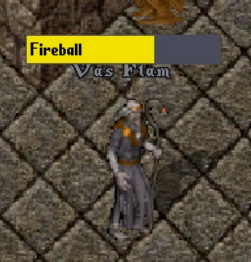
An enemy cast bar makes the spell and its progress visible while you react.
Ordinary creature spells take at least 1.5 seconds to cast, with 5–7 seconds of recovery after successful completion. Individual spell cooldowns and encounter scripts may make the interval longer or use a different cadence.
Damage interruption
A single direct hit removing at least 15% of maximum HP interrupts an interruptible cast. This is actual HP lost after mitigation and absorption: at 75 maximum health, a hit must remove at least 12 HP.
A 3-second grace period protects against another damage interruption. This does not lock your spells for three seconds. Poison, periodic damage and reflected damage do not trigger this rule.
A deliberate interrupt
Interrupting Strike requires a melee weapon, a target within one tile and a successful hit. If the target is casting a vulnerable spell, it imposes a 3-second casting lock, followed by another 9 seconds of interrupt immunity.
It costs 8 base stamina and has a 20-second cooldown. Some enemies can interrupt too. Uninterruptible casts, including creature Fire Breath and selected encounter abilities, cannot be stopped through the generic interrupt system.
06 / Put the rules to work
A few tools in your kit.
Costs below are base values before level scaling. These actions require the corresponding ability unlocks; they are not all granted to a new character.
| Action | Base result | Cost | Cast / cooldown |
|---|---|---|---|
| Bolt | Base 8 with variance + floor(INT/10) + magic bonuses | 8 mana | 1 s / 3 s |
| Heal | 8 + floor(INT/10), before healing bonuses | 6 mana | 0.8 s / 6 s |
| Blink | Targeted teleport, range 8 tiles | 10 mana | 1.2 s / 10 s |
| Renewal | 4 + floor(INT/30), every 2 s for 10 s | 10 mana | Instant / 12 s |
| Precise Attack | Next eligible light melee/ranged hit +20% | 6 stamina | 8 s preparation window / 6 s |
| Brace | Next direct physical hit reduced by 35%; melee weapon required | 8 stamina | 4 s window / 12 s |
| Focus | +10 percentage points of eligible autoattack accuracy against your current target; capped at 95% | 8 stamina | 8 s effect / 20 s |
Healing is limited to missing health. Restoration bonuses for healing another target do not automatically apply to self-healing. Bandages have a baseline 6-second channel and heal 20% of maximum health. Healing, refresh and mana potions share a 30-second recovery cooldown.
07 / Different layers, different decisions
Protection is more than armor.
An attack can encounter the defense curve, a shield block, protection redirection, timed defensive effects, reflection and absorption before becoming actual HP loss. The applicable layers depend on the attack and active abilities.
For example, configured Vanguard stance deals 60% of normal outgoing damage, adds max(3, roundAway(defense × 0.25)) to each defense, and gives +10 percentage points of shield block chance, capped at 60%. Its damage threat is 200% of ordinary threat. Surviving and holding attention are deliberate tradeoffs.
Magic Reflection redirects 30% of an eligible direct single-target magic hit after defense, consuming its charge. It excludes periodic, area and already-reflected hits; the reflected attack meets the recipient's own Magic Defense.
Explore the ability paths ↗08 / Learn from the exchange
See what actually happened.
The alternative journal has a dedicated Combat tab for your character, pets and summons. It records damage, misses, shield blocks, absorption, actual healing, deaths and visible effect changes without filling ordinary chat with combat messages.
Damage reports the HP actually removed, and healing reports the HP actually restored. A fully absorbed hit still appears; a heal that restores no health does not add a healing entry. The last 1,000 combat entries stay available during the current login, even after you close the journal.
Enable journal file saving in Settings to keep a separate combat file for each session. The in-game history clears when you log out.
Explore the custom client ↗